

Vision
The sky is never silent.
Above every roof, at every hour, something is speaking – quietly, quickly, in languages no one ever taught us. SSIFT grew out of a single question: who is transmitting up there, and how do we know it is really them. Collecting signals is only where this road begins.
01Method
We do not take signals at their word. We take them apart layer by layer: spectrum, modulation, frame, protocol, data. Every conclusion gets a trust level and a biography of its own – a record of the path that led us to it.
A matching frequency is not proof yet. It is only a suspect.
02Models
Where a signal resembles nothing we know, language models join the conversation. They are allowed to guess. They are not allowed to decide.
They suggest, and the engine measures.
03Scanner
The most interesting part, though, is what should not be there. The SSIFT scanner watches the parts of the sky that, according to the catalogue, are empty.
If the void speaks, we want to be the first to hear it.
04Workbench
Underneath, one workbench does the work: an analysis engine, a knowledge base of signals and transmitters, an orbit module, the scanner and an analyst console. The core is deterministic and needs no network – it carries its local LLMs with it.
05Memory
There is memory, too. The Forensics module runs the cases, keeps the evidence and records every decision, so that a report still makes sense a year from now.
This road has three stages.
-
Stage 01
The workbench
The first is the workbench: a tool you can really work with – to build the database, to analyse, to verify.
-
Stage 02
The investigation
The second is the investigation: deeper analysis built on our own collections and observations and on those of others, and in time on databases from many sources, joined into one.
-
Stage 03
The event horizon
The third lies at the event horizon.
An event horizon is the boundary from beyond which no message reaches the observer. An encrypted payload is its opposite: the message arrives complete, and still says nothing. We hold all of it in our hands, and we are still standing in front of a locked door.
But this boundary does not lie in physics. It lies in mathematics, in implementation flaws and in human habit. That is why SSIFT does not end at collecting and comparing signals.
We want to reach what they truly carry.

A developing toolkit for structured analysis of satellite RF recordings
An unknown signal produces observations before it produces answers.
SSIFT helps keep those observations, hypotheses and uncertainties connected.
RF Core
From raw samples to checked frames
The analysis engine. One command takes a recording through six layers and states the level of each claim.
$ rfcore analyze H6_esn0_7.sigmf-meta --auto --short --llm --llm-model anthropic/claude-fable-5-2
file:   H6_esn0_7.sigmf-meta (iq, 96 kS/s)
result: MSK / GMSK 9600 Bd; ax25, 33 frames OK; HARD6 > CQ; plaintext like
L0:     [matched EMISSION_DETECTED] emission +1209.9 Hz, BW99 8250.0 Hz, SNR 12.1 dB, 2 emissions
L1:     [matched MODULATION_HYPOTHESIS] fsk 9600.0 Bd, decision quality 0.40
L2:     [matched INTEGRITY_PASSED] ax25, 39 frames, CRC OK 33, bits msk_nrzi_g3ruh
L3:     [matched EVIDENCE_MATCHED] ax25 HARD6 -> CQ
text:   AcyUh{IB+3 TLAgs/C|KdkEj
L4:     [matched EVIDENCE_MATCHED] plaintext_like, entropy 6.50 bit/B
claims: L0.emission confirmed, L1.modulation confirmed, L1.symbol_rate confirmed, L2.framing confirmed, L3.protocol confirmed, L4.payload hypothesis, L1.profile hypothesis, L2.profile consistent
llm:    model anthropic/claude-fable-5-2
  L1: ACCEPTED (6 figures); model: family fsk 9600 Bd (high confidence)
      engine: family fsk, 9600 Bd, channel (1235.0, 13200.0): L2 ax25 with 33 frames that pass their check (the first analysis had none)
limits: LLM_HINTS
full report: drop --short; JSON: --output json
One command. The engine alone finds no frame; with --llm it finds 33 frames with a passed CRC. Hard case H6 of the benchmark: a synthetic GMSK signal whose clock line is lost in the noise. Without --llm the result is “outside the model”. Claude Fable 5.2 gets the measurements and 6 figures, not the recording, and proposes FSK at 9600 Bd. The engine tests the proposal; only the CRC decides. Real output, 32 s.
$ rfcore probe pslv-436500kHz-2018-01-13-095446.wav --start-sample 112000000 --max-samples 16000000 --short
file:     pslv-436500kHz-2018-01-13-095446.wav (7736.8 MB)
format:   cs16 (medium confidence), header 44 B (wav)
fs:       4000 kS/s (header), RF centre 436.500000 MHz
emission: #0 steady_band, -62.5 kHz, 506243 Bd (~115200), pm_residual?, +10.0 dB  [doubtful]
lines:    -968.8 kHz, +20.1 dB, steady (carrier or receiver spur)
full report: drop --short; analysis: rfcore analyze FILE

$ rfcore prepare-iq pslv-436500kHz-2018-01-13-095446.wav --center -975000 --bandwidth 40000 --decimation 80 --window 28 46 --start-utc 2018-01-13T09:54:46Z --rf-center-hz 436500000 --out-base picsat_18s
{
  "schema_id": "rfcore.prepared_iq",
  "schema_version": "1.0",
  "execution_status": "completed",
  "sample_rate_hz": 50000.0,
  "sample_count": 900000,
  "output_data": "picsat_18s.sigmf-data",
  [...] "processing": source hash, filter, window and the supplied values
}

$ rfcore analyze picsat_18s.sigmf-meta --short
file:   picsat_18s.sigmf-meta (iq, 50 kS/s)
result: BPSK 1196 Bd; ax25, 1 frame OK; PICSAT-2 > PICSAT; plaintext like
L0:     [matched EMISSION_DETECTED] emission +7805.6 Hz, BW99 2844.2 Hz, SNR 20.0 dB, 3 emissions
L1:     [matched MODULATION_HYPOTHESIS] psk2 1196.3 Bd, decision quality 0.99
L2:     [matched INTEGRITY_PASSED] ax25, 1 frames, CRC OK 1, bits nrzi_g3ruh
L3:     [matched EVIDENCE_MATCHED] ax25 PICSAT-2 -> PICSAT
text:   .....l*...F..................n.q.@.....C......... u..................................!X=._..........
L4:     [matched EVIDENCE_MATCHED] plaintext_like, entropy 3.79 bit/B
claims: L0.emission confirmed, L1.modulation confirmed, L1.symbol_rate confirmed, L2.framing confirmed, L3.protocol confirmed, L4.payload unknown, L1.profile hypothesis, L2.profile consistent
full report: drop --short; JSON: --output json
Three commands, each parameter set by the analyst. A public 4 MHz recording of the UHF band, 7.7 GB. probe reads 4 s from second 28 and reports a steady line at -968.8 kHz. prepare-iq cuts a 40 kHz channel around it, 18 s long, and records each step. analyze finds one AX.25 frame from PicSat with a passed CRC. Real output, 14.7 s, 2.5 s and 2.1 s; the JSON of the second command is shortened.
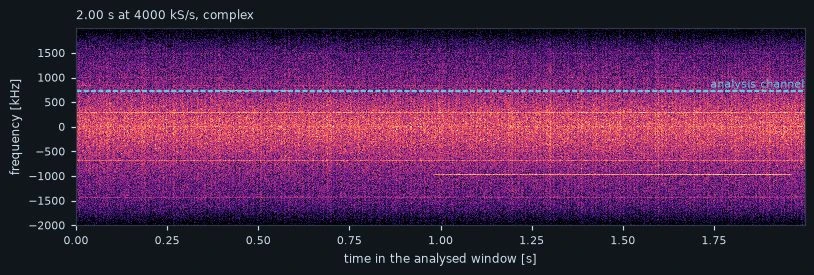
PSLV 2018-004 · 4 MHz band
7 emissions · PM 4801 Bd · 1 frame OK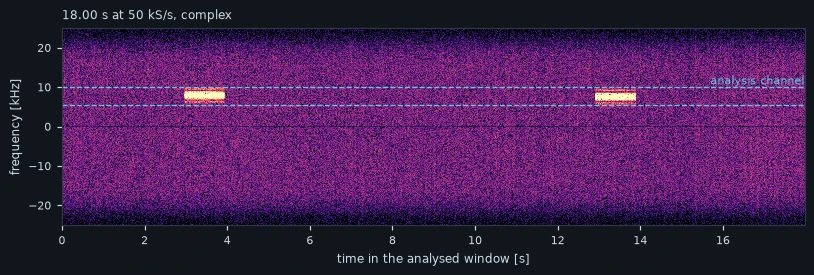
PicSat
BPSK 1196 Bd · AX.25 · 1 frame OK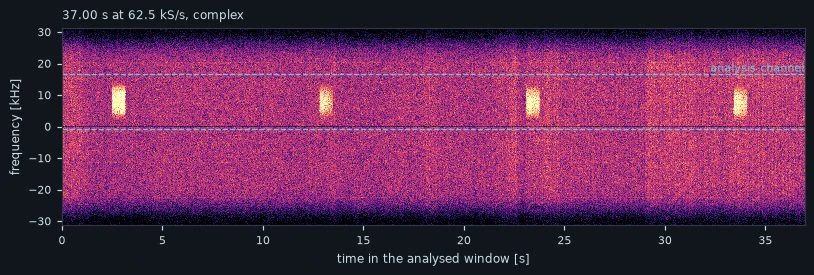
TigriSat
GMSK 9600 Bd · AX.25 · 1 frame OK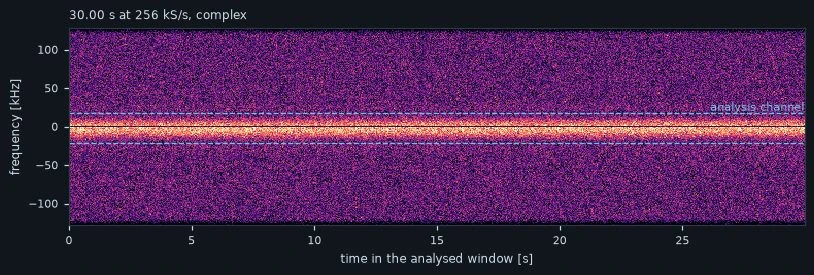
Roman Space Telescope
BPSK 19500 Bd · CCSDS AOS · 16 frames OK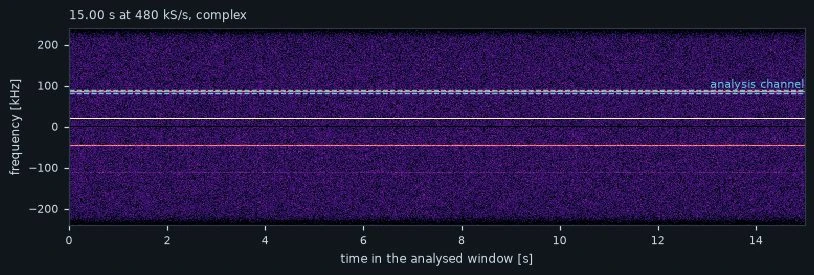
Queqiao
BPSK 2048 Bd · CCSDS · 7 frames OK--llm; 2 with the engine aloneWhy not 12 decoded recordings
The other 6 carry no frame that a check can confirm: an encrypted payload, radio teletype with no checksum, ADS-B pulses, GPS spread spectrum under the noise, an OFDM downlink, and a burst whose frames fail their check. For these the correct result is a class name or “no frame”. RF Core gives that result and does not invent a frame. A frame counts only when its check passes.
RF Core benchmark, 2026-11-23 · 2700 synthetic and 12 public recordings
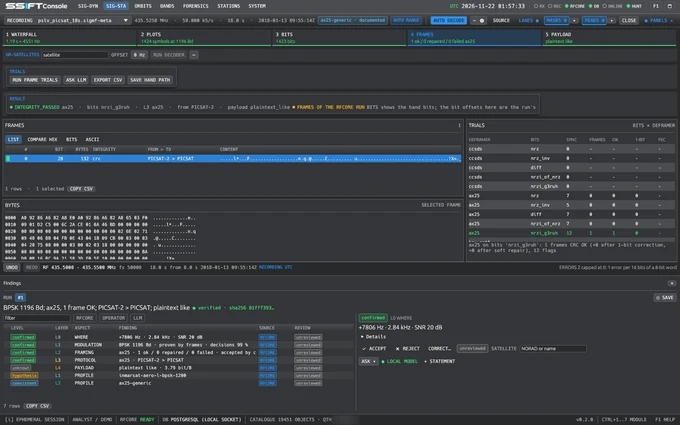
SSIFT Console
One desk for the analyst
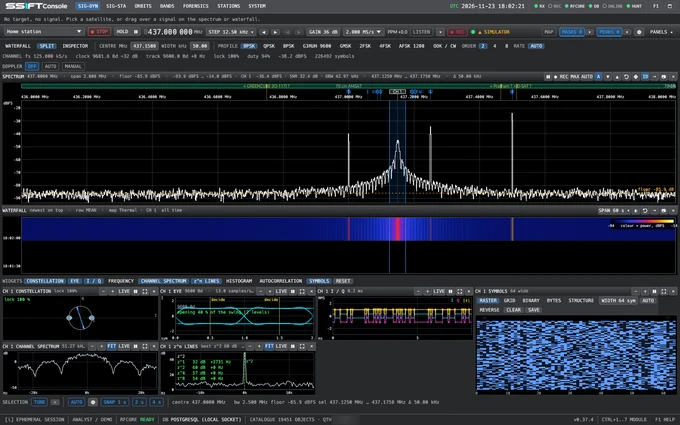
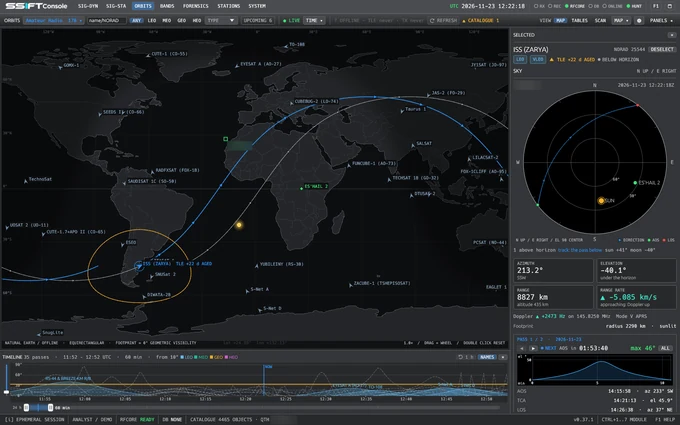
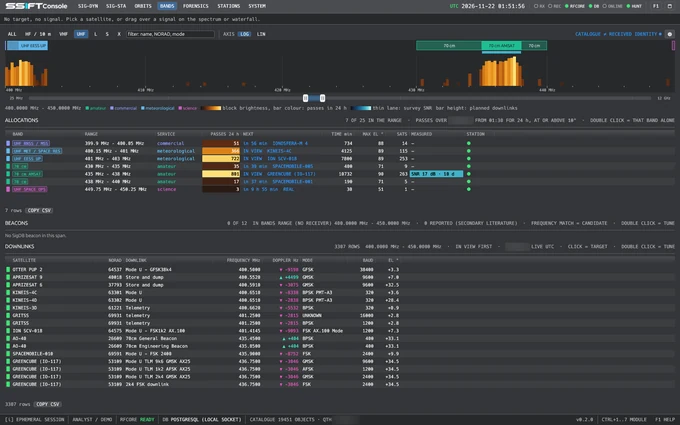
Orbits, live and recorded signals, and the findings of RF Core in one interface. The analyst accepts, rejects or corrects each finding.

Project status
In active development
SSIFT is an independent project led by Radek Zdończyk. It brings more than 12 years of cybersecurity experience to RF: analysis of the unknown, work built on evidence, and a refusal to take easy answers.
Open to collaboration. Let’s talk.